Last updated on by MRC
Rehabilitation medicine has entered a transformative era. Traditional physical therapy, while effective, often requires months of highly repetitive, manual exercises that can feel monotonous and exhausting for patients recovering from stroke, brain injuries, or neurological conditions.
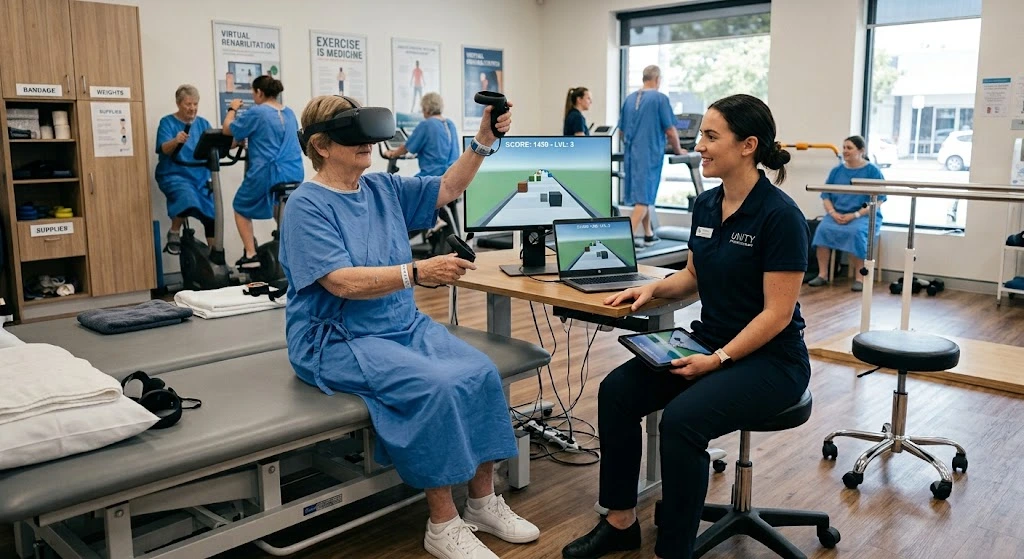
Enter Virtual Reality (VR) and Robotic Rehabilitation, a ground-breaking approach that blends immersive digital environments, precision robotics, and cutting-edge neuroscience. By turning physical exercises into interactive visual tasks, VR-based therapy drastically enhances engagement while accelerating physical recovery.
Also Read: The Role of Wearable Technology in Monitoring Rehabilitation Progress
Motor recovery isn’t just about training muscles; it’s about retraining the brain. Virtual Reality acts as a powerful catalyst for neural repair through several key mechanisms:
The human brain possesses a remarkable ability to reorganize itself by forming new neural connections, a process known as neuroplasticity. When stroke or paralysis damages brain pathways, high-frequency, repetitive, and goal-directed movements are required to build alternative neural circuits. VR therapy delivers structured, high-repetition exercises in gamified environments, stimulating neuroplasticity far faster than conventional manual exercises.
VR environments simultaneously stimulate multiple senses, primarily vision, audition, and proprioception (the brain’s awareness of body position in space). When a patient moves a limb in the real world and instantly sees a corresponding action in a virtual space, the brain receives reinforced sensory feedback. This multisensory integration accelerates the restoration of joint position sense and spatial awareness.
One of the greatest hurdles in rehabilitation is incorrect movement patterns or compensatory behaviors. VR platforms integrated with robotic sensors offer real-time feedback. Patients receive immediate visual and auditory cues on screen regarding their posture, angle of movement, and speed, enabling them to make instant self-corrections under guided supervision.
No two recovery journeys are identical. VR therapy utilizes adaptive learning algorithms to analyze a patient’s motor performance in real time. As muscle strength, reaction time, and range of motion improve, the system automatically adjusts difficulty levels, keeping exercises challenging yet achievable without risking strain or injury.
Combining VR applications with robotic movement assistance offers profound physical and psychological advantages:
If you or a loved one is seeking advanced neurological rehabilitation or specialized paralysis treatment in Kolkata, Medical Rehabilitation Center is leading the way in modern care.
As a pioneer in neuro-ortho rehabilitation across Eastern India, integrates state-of-the-art robotic physiotherapy, interactive balance boards, and VR-driven motor retraining under one roof. Backed by a multidisciplinary team of physiatrists, neurologists, physiotherapists, and rehab experts, MRC designs personalized recovery programs tailored to individual needs. With full-time indoor rehabilitation facilities and dedicated care operating 365 days a year, MRC offers a safe, evidence-based, and highly effective environment to help you regain mobility, independence, and confidence.
VR-based rehabilitation uses immersive digital environments and motion sensors to guide patients through interactive physical exercises. It helps improve motor function, muscle strength, and coordination by making therapy engaging and precise.
VR stimulates neuroplasticity the brain’s ability to rewire itself, by offering high-repetition, task-oriented exercises with real-time visual feedback, aiding in neural pathway retrain after a stroke or paralysis.
Yes. VR and robotic rehabilitation sessions are fully supervised by experienced physiatrists and physiotherapists in a safe, controlled environment tailored to each patient’s physical capability.
Medical Rehabilitation Center (MRC) in Kolkata provides state-of-the-art robotic and virtual reality rehabilitation along with comprehensive indoor care for paralysis, stroke, and spinal cord injury recovery.