Last updated on by MRC
Recovering the ability to walk is one of the most common — and most misunderstood — goals in rehabilitation medicine. It isn’t a single skill that returns overnight; it’s rebuilt in stages, through repetition, and often with the help of technology most patients have never heard of. At the Medical Rehabilitation Centre in Kolkata, our physiotherapists guide patients through exactly this process every day, from the first supported step to walking independently again.
Gait training is a structured physiotherapy program designed to help patients recover or improve their walking pattern after an injury, surgery, stroke, or neurological condition. It focuses on rebuilding strength, balance, coordination, and confidence, all of which are needed to move from one point to another safely.
Conditions that commonly require gait training include:
No two patients walk into gait training with the same starting point, and no two rehab plans look identical. That said, most patients move through three broad phases of recovery.
Before a patient can take a single step, the body needs to relearn the basics. This is the stage of Foundational Control, and it is often the slowest, most patient-heavy part of rehab. It is also the most important.
At this stage, therapists focus on:
Think of it as rebuilding the base of a house before adding the walls. Skipping this stage or rushing through it usually leads to poor walking patterns later, which can cause pain, fatigue, or compensatory habits that are hard to undo.
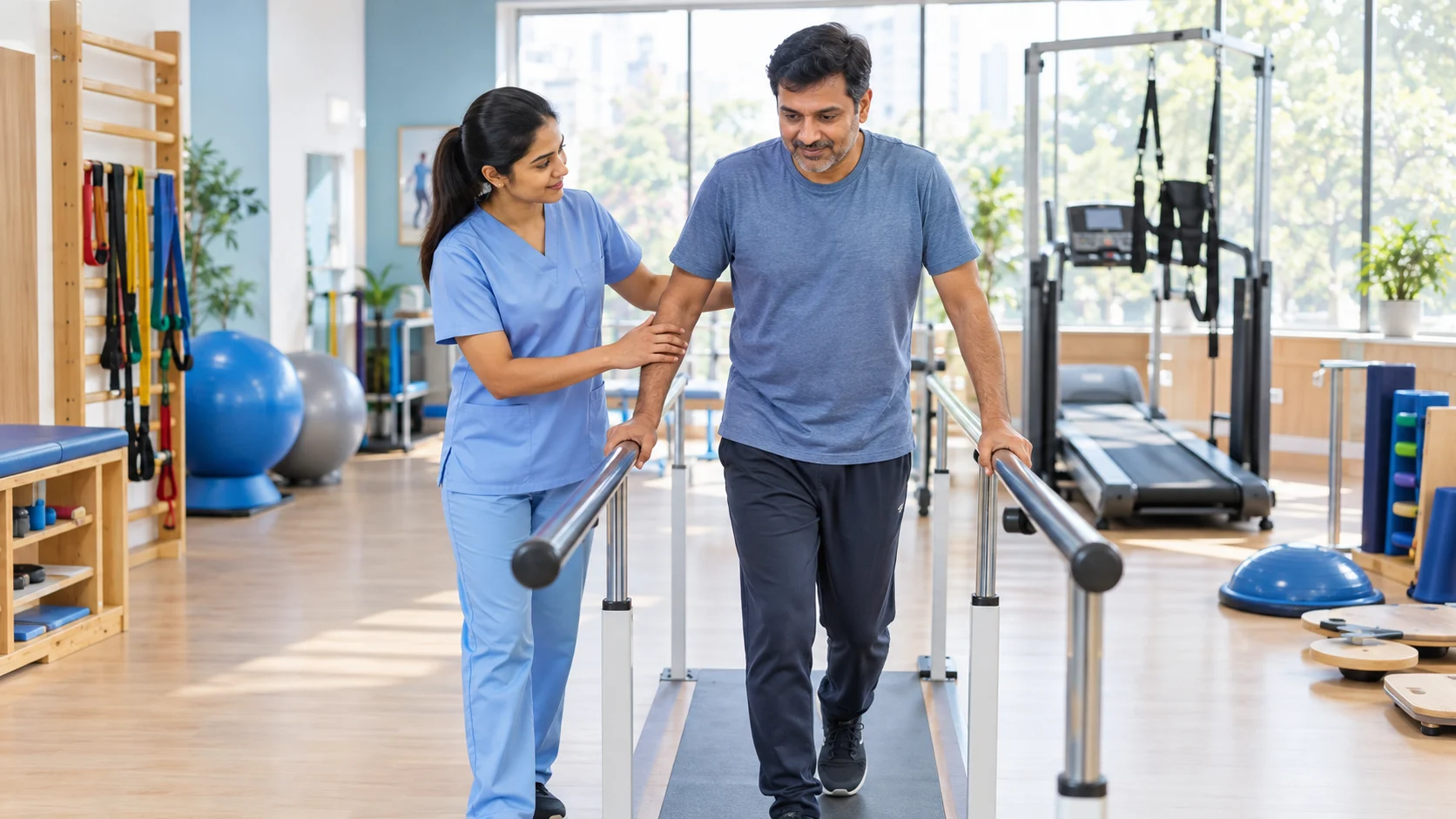
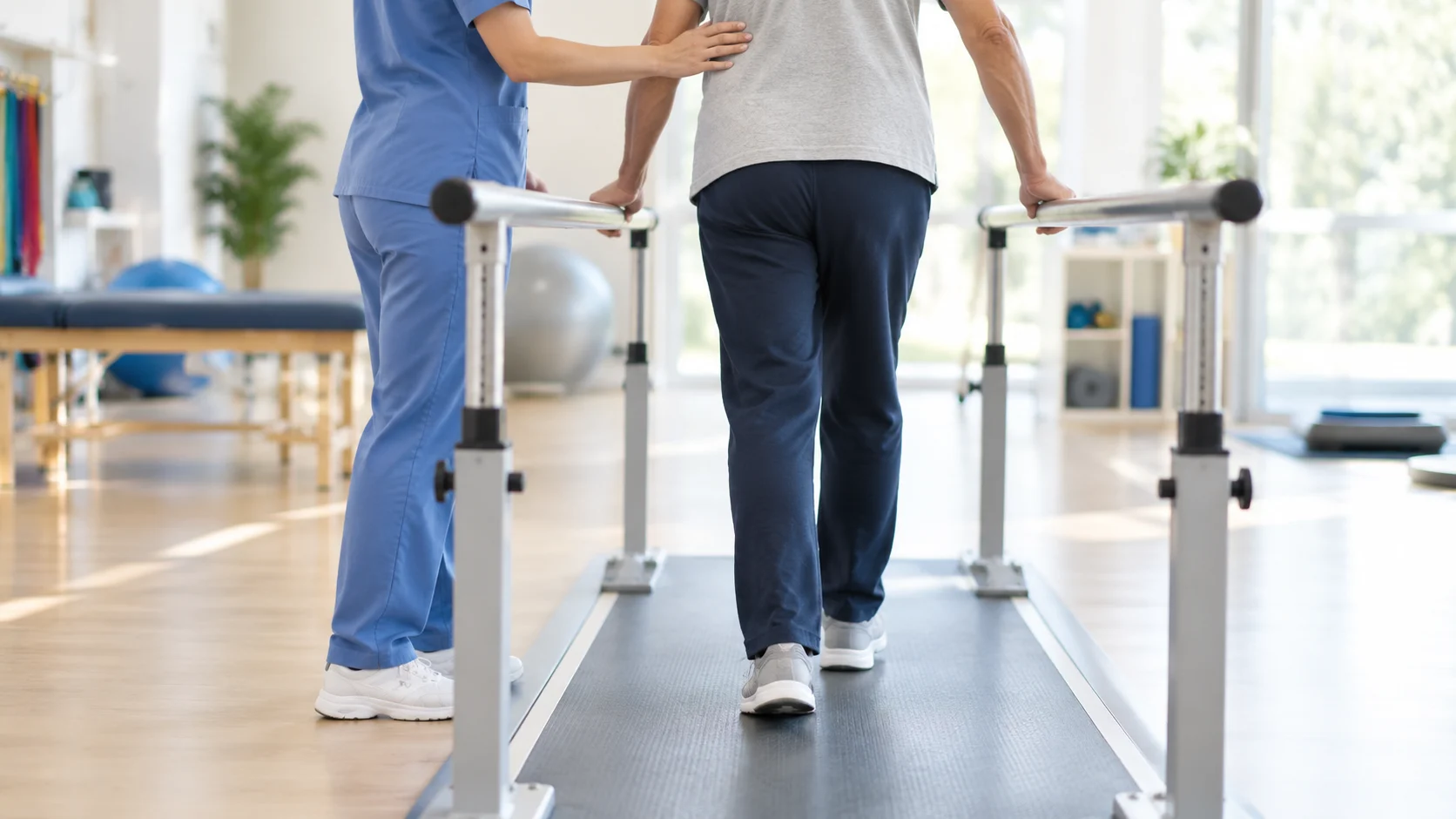
Once a patient has enough foundational control, they move into Supported Walking. This is where actual steps begin, but with assistance. That support might come from a therapist physically guiding the patient, parallel bars, a walker, or specialised rehab equipment.
The goal here is repetition with safety. Patients need to practice the walking cycle, heel strike, weight shift, push-off, and swing, hundreds of times before it starts to feel natural again. This is also where technology like Body-Weight Support (BWS) systems and Robotic Exoskeletons often come into play, which we cover in detail below.
The final stage is Advanced Mobility, where patients work toward walking independently, without external support, on varied surfaces, and eventually outside a controlled clinic environment. This includes:
Reaching this stage does not mean therapy is over. Many patients continue with maintenance sessions to preserve gains and prevent regression, especially those recovering from progressive neurological conditions.
Gait training has changed significantly over the past decade. What used to rely almost entirely on manual therapist support now often includes advanced rehab technology that speeds up recovery and improves outcomes.
Body-Weight Support systems use a harness to take a percentage of the patient’s weight off their legs while they practice walking, usually on a treadmill. This allows patients who cannot fully support themselves to still practice a correct walking pattern early in recovery, without the risk of falling.
As strength and control improve, the amount of support is gradually reduced. This lets patients build confidence in stages, rather than being forced into full weight-bearing before they are ready.
Robotic Exoskeletons are wearable devices that support and guide the patient’s legs through a walking motion. For patients with significant weakness or paralysis, an exoskeleton can help simulate the correct movement pattern hundreds of times in a single session, something that would be physically exhausting for a therapist to do manually.
This repetition matters because the brain relearns movement through consistent, correct practice, a concept known as neuroplasticity. Robotic exoskeletons make that repetition possible even for patients who are far from walking independently.
Get more insights on: Gait Training with Robots: A New Hope for Recovery
Functional Electrical Stimulation, or FES, uses small electrical impulses to activate weak or paralysed muscles at the right point in the walking cycle. For example, in patients with foot drop, a common issue after stroke, FES can stimulate the muscles that lift the foot at exactly the right moment, helping create a more natural step.
FES is often used alongside other gait training methods rather than as a standalone treatment, and it can be particularly effective for neurological conditions where muscle activation, not just muscle strength, is the main barrier to walking.
No single tool or technique works for every patient. A stroke survivor with one-sided weakness needs a different plan than someone recovering from a hip replacement or a patient managing Parkinson’s disease. At MRC, our physiotherapists assess each patient’s condition, strength, balance, and goals before designing a gait training program, and that plan is adjusted continuously as the patient progresses.
This is also why gait training works best under professional supervision. Attempting to walk before the body is ready, or practising incorrect movement patterns without correction, can slow recovery or lead to new injuries.
Learning to walk again is rarely a straight line. It moves through stages, from rebuilding basic control, to walking with support, to eventually moving independently and confidently. With the right combination of therapist expertise and modern tools like Body-Weight Support, Robotic Exoskeletons, and Functional Electrical Stimulation, that journey becomes shorter and safer for many patients.
If you or a loved one is beginning this journey, MRC’s team of physiotherapists in Kolkata is here to guide every stage of gait training, from the first supported step to walking on your own again.
It depends entirely on the condition and severity of the injury. Some patients progress through the stages in a few weeks, while others, especially those recovering from stroke or spinal cord injury, may need several months of consistent therapy.
Gait training should not be painful. Patients may feel muscle fatigue or mild soreness, similar to any physical exercise, but therapists closely monitor progress to avoid overexertion or injury.
Yes. Gait training is commonly used for elderly patients recovering from falls, fractures, or joint replacement surgery, and it plays a major role in reducing the risk of future falls.
Body-Weight Support reduces the load on the legs using a harness system, usually paired with a treadmill. Robotic Exoskeletons actively guide the leg through the walking motion. Both are often used at different stages of the same recovery journey.
Not always. Gait training is typically recommended after surgeries or injuries that affect strength, balance, or the nervous system’s control over walking, such as hip or knee replacement, spinal surgery, or neurological events like stroke.
MRC (Medical Rehabilitation Centre) offers personalised gait training programs in Kolkata, combining experienced physiotherapists with advanced rehab technology to support patients at every stage of recovery.